The People, Places and Practices Behind Our Cashmere
The Journey Begins
Before an Oats & Rice piece reaches your wardrobe, it passes through many skilled hands.
We travel regularly to Inner Mongolia in China to visit the GOTS-certified organic farms we work with and to follow our cashmere through each stage of production.
On this page, you’ll see that journey firsthand. From the vast grasslands and herders to the yarn spinners, knitters, and craftspeople who turn raw fibre into a finished piece.


Why We Visit
Experiencing It Ourselves
Brands like to talk about where their products come from. We spend time in the places where ours begin. Walking the grasslands and meeting local people gives us a deeper understanding of the process than a brochure ever could.
Listening and Learning
The farmers spend every day caring for the animals and managing the land. We hear about the challenges they face, the improvements they have made, and the realities of maintaining an organic pasture in a harsh climate.
Looking for Better Ways
We also use this time to ask questions. Could the experience be improved for the animals or the people involved? Small changes may seem insignificant on their own, but over time they can make a meaningful difference.
Every year, we travel to (the very windy) regions of Inner Mongolia in China. If we are going to tell the story of our organic cashmere, we believe we should follow it back to its source.


Meeting the Goats
Meeting the Herd
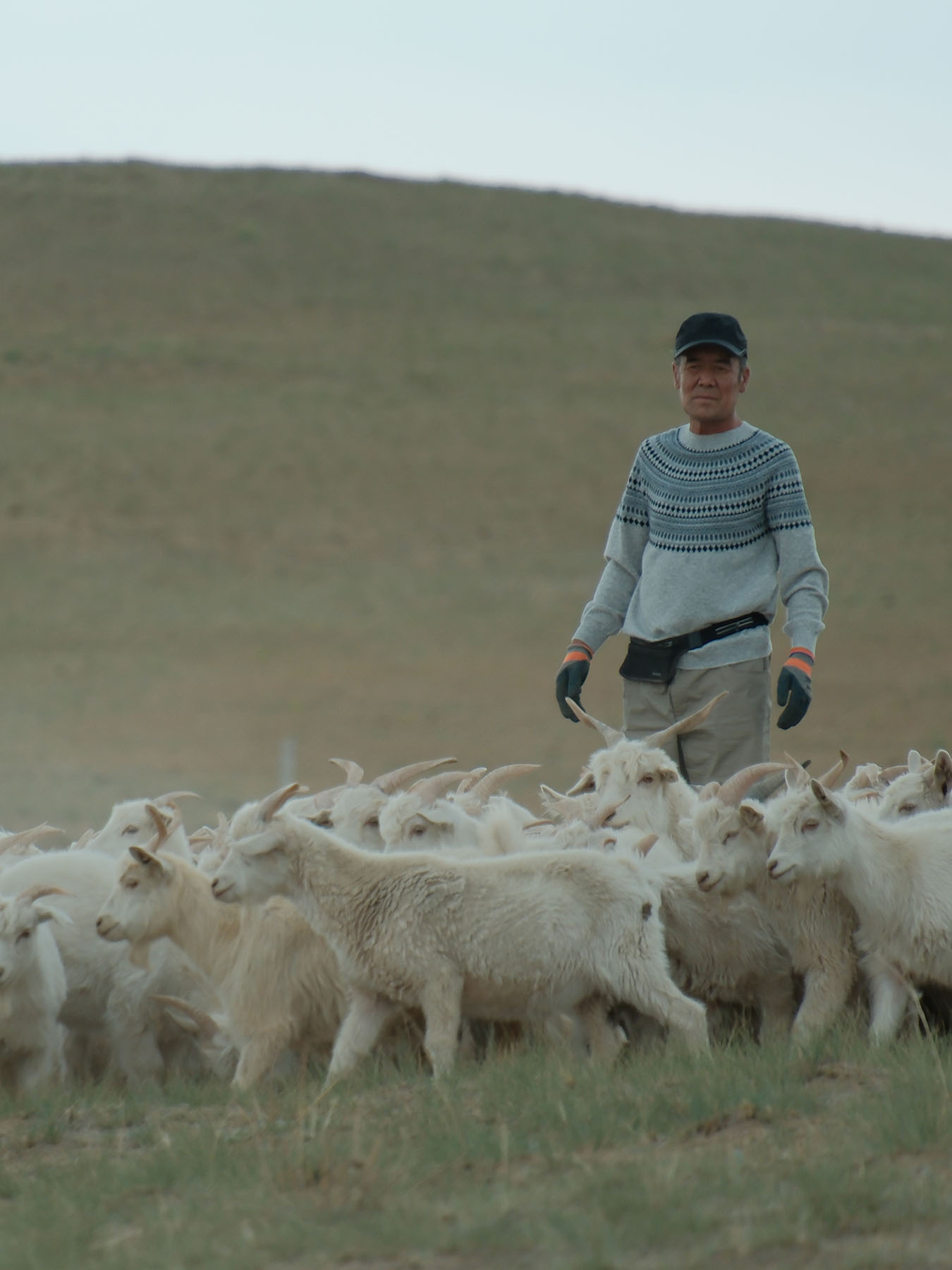
One of the most enjoyable parts of our visit is spending time with the goats. Seeing them roam across the pasture reminds us that cashmere is ultimately a natural fibre, grown by animals rather than manufactured in a factory.
Visiting Farming Families
We are welcomed into the homes and farms of the families who care for the goats. Their knowledge has been passed down through generations, and their connection to the animals is something that can only be experienced in person.
Spring’s New Arrivals
Our visits coincide with the arrival of newborn kids. Curious, playful, and very cute, they quickly become everyone’s favourite part of the trip. Watching a new generation begin is a reminder that sustainability is about long-term thinking.
Everything begins here, in the grasslands of Inner Mongolia, where adorable cashmere goats spend their days grazing across vast open landscapes.


Collecting the Fibre
A Worthy Change
Traditionally, cashmere was collected by combing goats with metal combs. While effective, it takes a long time and is stressful to animals with thick winter coats.
A Gentler Approach
Today, the fibre is collected mainly through careful shearing with electric clippers. Sensitive areas are trimmed by hand for greater precision and care.
Back on the Pasture
With their heavy winter coats gone, the goats head straight back to the grasslands. Watching them graze freely again is one of the most satisfying moments of the journey.
As winter comes to an end, the goats no longer need their thick coats. This is when the cashmere collection begins.


Sorting Raw Fiber
The First Inspection
When the raw fibre arrives, it is far from becoming yarn. It contains different grades of cashmere, coarse hairs, dust, and bits of debris picked up on the grasslands.
Skilled Hands at Work
The sorting process is laborious and relies heavily on experience. Workers carefully inspect and separate the fibre, identifying the qualities that will ultimately determine the softness and consistency of the finished yarn.
Preparing for the Next Stage
By the end of the process, the fibre is clean, sorted, and ready for the next stage of production. It is a very important step, as much of the final quality is determined here.
The freshly collected fibre leaves the pasture and moves to the next stage of production. At the yarn mill, it will be cleaned, sorted, and prepared for spinning into yarn.


Spinning the Yarn
Spotless Clean
Cashmere is an exceptionally fine fibre. Maintaining a clean environment is essential, as even small contaminants can affect the quality of the finished yarn.
Precision at Every Step
The fibre passes through multiple stages that align, refine, and prepare it for spinning. Watching the machinery in motion is mesmerising and satisfying.
Fibre Becomes Yarn
At the end of this process the fibres collected from the goats are now yarn, ready to become beautiful cashmere products.
This is where loose cashmere fibre takes on a new form. Through a series of carefully controlled processes, it becomes the soft yarn that will later be knitted into finished pieces.

Making The Collection
From Yarn to Fabric
What arrives at the factory is simply yarn on a cone. From here, it passes through knitting, linking, washing, and finishing before becoming a finished piece.
Craftsmanship in Every Piece
While machinery plays an important role, skilled people remain at the centre of the process. Their experience helps ensure consistency and quality throughout.
Designs Come to Life
This is perhaps our favourite stage. Designs that once existed only as sketches and samples gradually become real scarves, shawls, hats, and gloves ready to be worn around the world.
Once the yarn is complete, it arrives at the knitting factories, where our designs finally begin to take shape.

A Shared Effort
More Than Sustainable
Sustainability’s predominant focus is on animals and the environment. GOTS certification also includes strict social standards, reflecting our belief that the people behind our products matter just as much.
Standards We Stand Behind
We only work with partners who provide fair pay, safe working conditions, paid holidays, and meaningful benefits.
The Human Side of Cashmere
The farmers, technicians, knitters, inspectors, and craftspeople are all part of the story. Their skill, dedication, and experience shape every product we make. Behind every finished piece is a community of people whose work deserves to be seen and appreciated.
Every item we make passes through many skilled hands before reaching yours.